
AI search

AEO and GEO: get recommended in AI answers, not just ranked in search.

Buyers now ask AI assistants for a shortlist. AEO and GEO are how you get on it. We measure where you stand against named competitors, fix what decides it, and re-measure on the same questions.

Definitions

AEO, GEO and AI Overviews, in plain words

Works on your pagesAEOanswer engine optimization
Making your content the direct answer in AI assistants, featured snippets and voice. AEO works on your pages.
Works on other websitesGEOgenerative engine optimization
Getting named and cited inside AI-generated answers from ChatGPT, Gemini, Perplexity and others. GEO works on what other websites say about you.
Sits at the top of GoogleAI Overviews
Google's AI-generated summaries at the top of search results.

AEO works on your pages; GEO works on what other websites say about you.

All terms in the glossary
What we measure03 screens

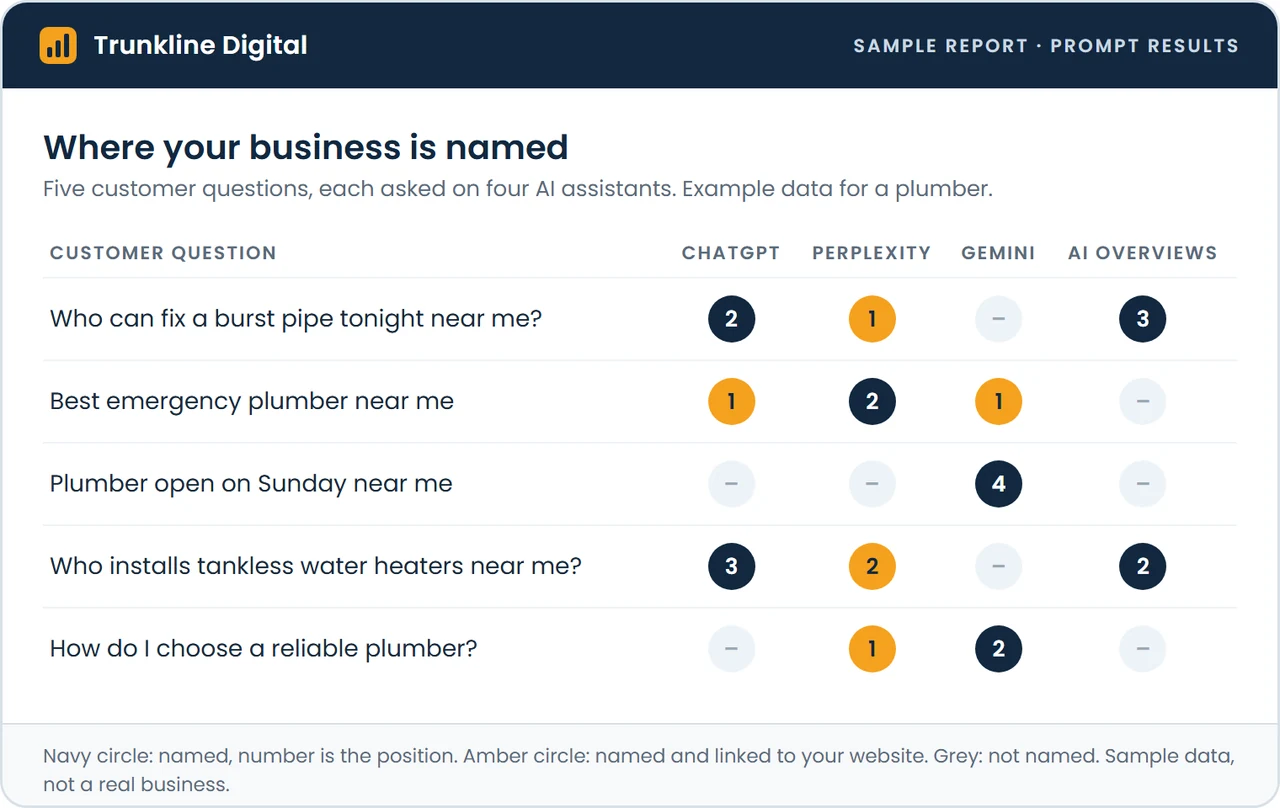
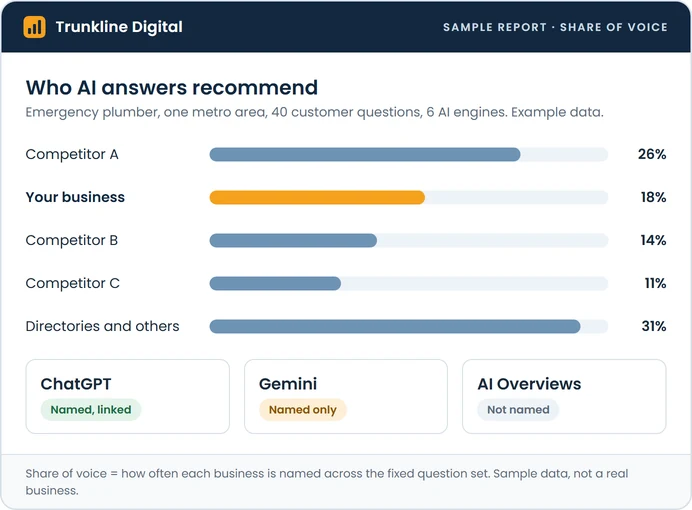
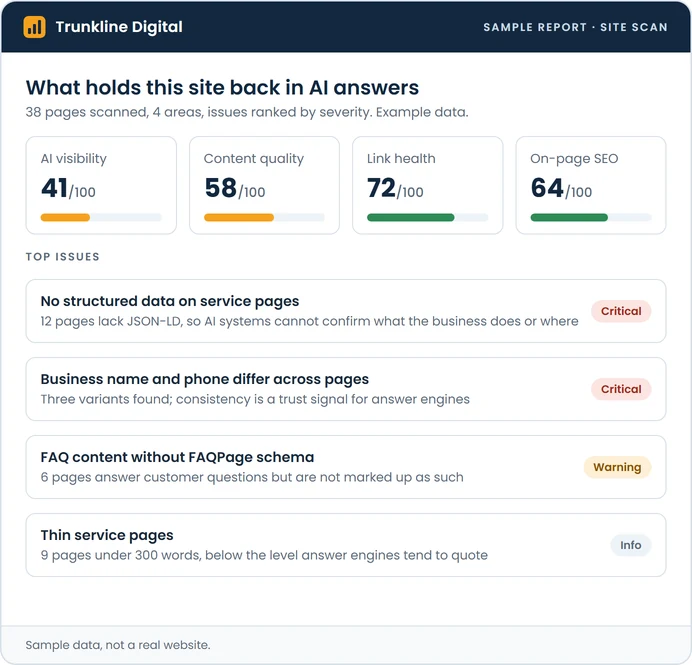
Three screens, and you see all of them

Every AI search report we send is built from these three views. Nothing is summarized into a single score you have to take on trust.

Sample report: a numbered position where the business was named, in amber where the answer also linked to its website. Example data.

Sample report views with example data. Real reports carry your business, your competitors and your questions.

What the numbers mean04 figures

Four figures on every report, in plain words

  • Visibility score

    A number out of 100 that combines how often you are named, how often you are linked, and how high in the answer you appear, across all the questions and engines in your set. It moves slowly. That is the point.

  • Share of voice

    Of all the businesses the AI answers recommended for your questions, the percentage of recommendations that were you. The rest of the chart is your competitors, by name.

  • Named vs linked

    Named means the answer mentioned your business. Linked means it also pointed to your website. A mention puts you on the shortlist; a citation sends the visit. We track both, separately, and never add them together.

  • Engine coverage

    How many of the six engines named you for a given question. A business that only ChatGPT knows about has a different problem from one that no engine knows about, and the fix is different too.

What you receive with them: the dated scan, the exact prompts, evidence excerpts for anything found, and the prioritized fix list. Every scan is kept, so the comparison is always against your own earlier position.

Worked example

A mention and a citation, side by side

This is how a report records one customer question. The business name and web address are placeholders.

Customer questionWho can do an emergency plumbing repair near me today?Example data
ChatGPTMentioned, no link

For emergency plumbing repairs in your area, a few local companies come up in reviews, including Example Plumbing Co., though opening hours vary.

Recorded as named in position 3. The answer gives the reader no way to reach the website.

A mentionThe answer names the business, but there is nothing to click. The customer still has to go and look for you.
PerplexityCited, linked

Example Plumbing Co. offers same-day emergency repairs and lists the areas it covers on its website.

Recorded as named in position 1 and linked. The reader can click through to the page.

A citationThe answer names it and links to the page that answers the question. A mention puts you on the shortlist; a citation sends the visit. We track both, separately.
Four workstreams04 workstreams

What we change

  1. On your site

    Answer-first content

    Pages that state the answer a buyer is looking for in the first lines, so an assistant can quote them.

  2. On your site

    Structured data and AI crawler access

    Schema that labels what your business does, and robots rules that let AI crawlers read your site.

  3. Off your site

    Off-site authority

    The reviews, directories, press and community mentions AI assistants lean on when they choose who to name.

  4. On your site

    Technical foundations

    Site structure, speed and clean HTML, so every page can be read by search engines and AI systems alike.

Limits and evidence04 points

What we do not promise

Two of these are things we will not claim. Two are limits in the data itself. Each one says which, and links to the source where there is one.

Not promised

No guaranteed inclusion

No agency can guarantee a specific business is mentioned or cited by an AI system. Google's own guidance rejects special-markup or inauthentic-mention shortcuts and makes no inclusion guarantees.

Not promised

No invented arithmetic

We don't convert a mention into an assumed number of jobs or amount of revenue. There is no measured causal chain from visibility to revenue in this work, and we won't manufacture one to make our work look better.

Our own reporting policy
Known limit

Reporting keeps improving, and has limits today

Google's Search Console now includes a generative-AI performance view with page, country, device and date dimensions. It reports impressions; it does not currently provide clicks, CTR or conversions broken out for AI surfaces. AI Overviews and AI Mode are reported together, not separately, and there is no query data. Because the report gives no click figure, a click from an AI Overview or AI Mode answer cannot be told apart from an ordinary search click in Search Console.

Known limit

Lab checks are not field data

Where we reference page-speed or accessibility measurements, we say whether they're lab results or field data, and we don't label a single test as real-world performance.

What OpenAI says about ChatGPT search

"OAI-SearchBot is used to surface websites in search results in ChatGPT’s search features."

Sites that block it will not be shown in ChatGPT search answers. In OpenAI's words: "Sites that are opted out of OAI-SearchBot will not be shown in ChatGPT search answers, though can still appear as navigational links."

OpenAI crawler documentationQuotes and sources on this page last checked against the live pages on 11 September 2026.
Agreed per client

Engines we track

  • ChatGPTOpenAI
  • GeminiGoogle
  • PerplexityPerplexity AI
  • ClaudeAnthropic
  • GrokxAI
  • Google AI OverviewsGoogle Search
Questions05 answered

Before you ask for the scan

Which AI platforms do you check?

We cover ChatGPT, Perplexity, Gemini, Google AI Overviews, Claude and Grok. We agree with you which of these matter for your customers before the first scan, and the report lists them with the interface version where that is available.

How do I know a mention actually happened?

Every scan records the exact prompt, the engine, the date and the answer text. A question that was not run is recorded as not tested, never as zero visibility. You can open any scan and read the answer yourself.

Can this replace SEO or ads?

No. AI search sits alongside SEO and, where relevant, paid media. See the services page for how these fit together, and our work for what that has looked like in practice.

Is the visibility score the whole market?

No. It describes your agreed question set on the engines we scan, not every question anyone could ask. That is why we fix the questions and engines before the first scan and never change them between scans: the score is only useful as a comparison against your own earlier position.

What is the Competitor Gap Scan?

We run ten of your buyers' questions through six AI engines, record your share of voice against up to three named competitors, and walk you through the results on a 20-minute call. It is free and takes two business days. You see whether AI answers name you, link you or recommend someone else.

Next step

See who AI recommends instead of you

Tell us your website and up to three competitors. Within two business days we run your buyers' questions through six AI engines and walk you through the results on a 20-minute call.

  1. You send the formYour website, up to three competitors and your country.
  2. We run the scanYour buyers' questions through six AI engines.
  3. We walk you through itA 20-minute call, within two business days.

Your Competitor Gap Scan

Free. Results in two business days, walked through on a 20-minute call.

Required
Required
We send the results here.
Required
Optional
Only if you would like a call.

We use your details only to run the scan and contact you. See our privacy policy.

Prefer to talk? (737) 423-8147