

On this page
- Why a Top Ranking Does Not Guarantee Leads
- A Website That Search Engines and AI Tools Can Understand
- Search Visibility, Local and National
- Getting Named in AI Answers
- Paid Ads and Social Media
- Turning Visits Into Leads
- Measure What Actually Brings In Business
- Mistakes That Quietly Waste Budget
- A Sensible Order of Work
- Where to Start
- Frequently Asked Questions
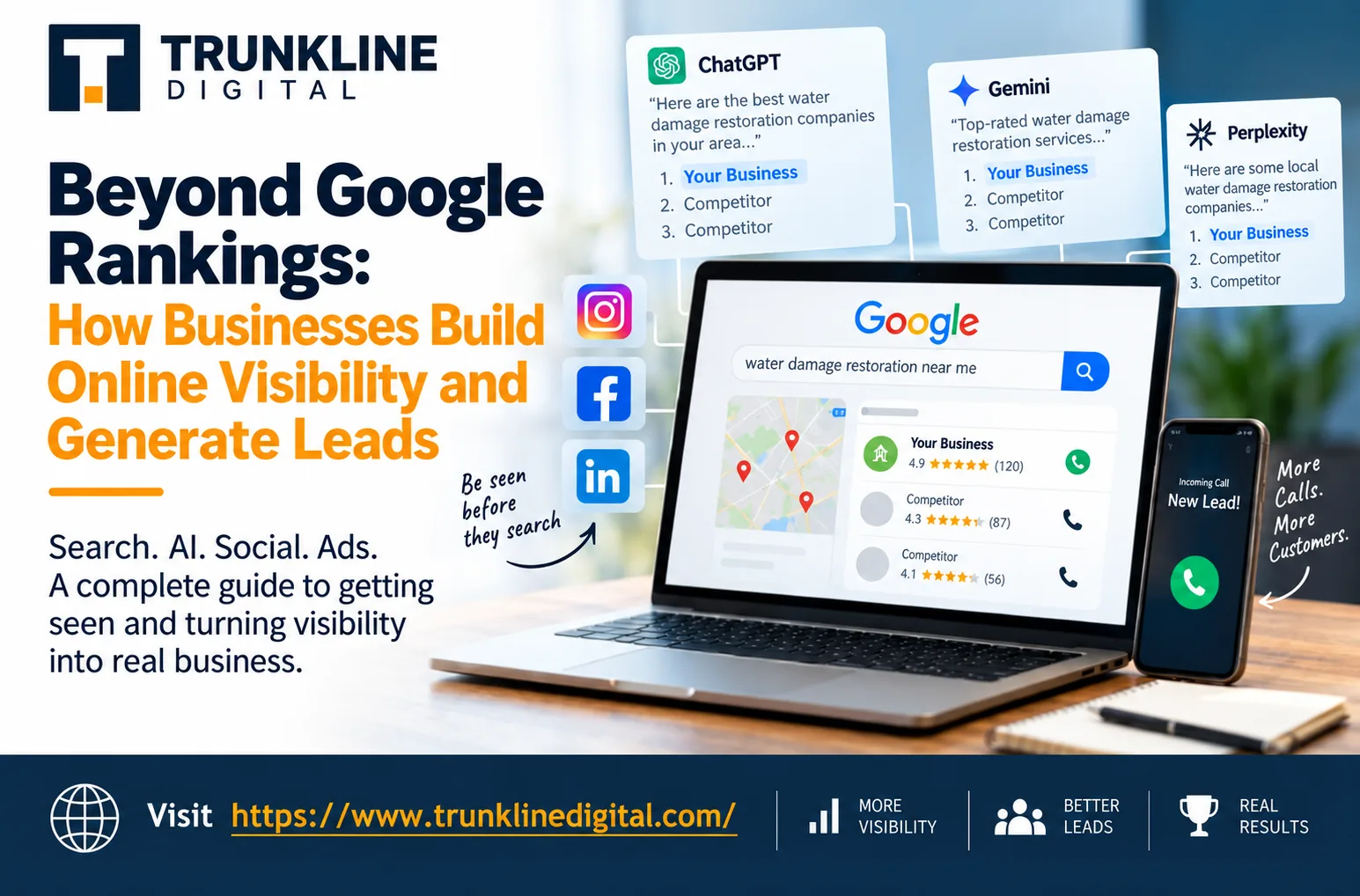
Picture a local water damage restoration company that sits on page one of Google for its main search term. The owner checks the ranking report every month and feels good about it. Yet the phone is quiet. Some inbound calls are never counted, a competitor gets named when customers ask ChatGPT who to hire, and part of the ad budget goes to searches that have nothing to do with the service.
Situations like this are common, and they show why rankings alone no longer describe online visibility. This guide explains how visibility works across search, AI assistants, and social media, and how each part connects to lead generation. Read it in order the first time, then use each section as a checklist.
Why a Top Ranking Does Not Guarantee Leads
Rankings measure position, not business results
A ranking tells you where a page sits for one search term. It does not tell you whether the visitor called, filled in a form, or left within five seconds. Two businesses can hold the same position and bring in very different amounts of work, depending on how clear the page is, how fast it loads, and how easy it is to make contact.
Where buyers start looking now
Customers no longer begin in a single place. Most buying journeys touch at least one of these:
- Search engines
- Google and Bing, including map results, local listings, and paid placements
- AI assistants
- ChatGPT, Gemini, Perplexity, Claude, Grok, and Google's AI Overviews, which summarize an answer and name a handful of brands
- Social feeds
- Facebook, Instagram, and LinkedIn, where many brands are seen for the first time before anyone searches
A business that appears in only one of these loses the buyers who started in the others.
Different businesses, different starting points
The mix changes with the type of business:
- Service businesses usually gain most from local SEO, a complete Google Business Profile, and call tracking
- SaaS and software companies depend on comparison content, clear product pages, and being named when buyers ask assistants for tool recommendations
- Marketplaces and platforms need pages that explain the offer to both sides of the market
- Local and regional brands benefit from consistent listings, reviews, and location pages
Layer OneA Website That Search Engines and AI Tools Can Understand
Every channel eventually sends people to your website, so it is the first thing to get right. A slow or vague site wastes the attention you earn everywhere else.
Make each page answer one question clearly
Search engines and AI tools both struggle with pages that try to say everything at once. Give each service its own page, and make it state what the service is, who it is for, and where you offer it.
What a strong service page covers
- A headline that names the service and the area
- A plain description of the problem it solves
- How the process works, step by step
- What affects the price
- Proof such as reviews, project examples, and licenses
- One visible way to get in touch
Speed, mobile use, and clean structure
Most local searches happen on a phone. Test your pages on a mobile connection, make phone numbers tap to call, and keep forms short. Internal links between related pages help visitors and crawlers see how your content fits together.
Structured data
Structured data, also called schema markup, labels the facts on a page: business name, address, services, reviews, and frequently asked questions. It gives search engines and AI tools an unambiguous summary instead of leaving them to guess from your layout.
Layer TwoSearch Visibility, Local and National
Start with search intent
Keywords fall into rough groups by intent. Informational searches, such as "what causes mold after a flood," come from people who are learning. Commercial searches, such as "best water damage restoration company," come from people comparing options. Transactional searches, such as "emergency water extraction near me," come from people ready to call.
Long-tail phrases like these are searched less often than broad terms, but the people behind them usually want to act. A page written for one specific phrase tends to do more work than a page aimed at a broad head term.
Build topic clusters
A topic cluster is one central guide supported by narrower pages, each answering a specific question and linking back to the main guide. Over time this shows depth on a subject, which helps search engines and AI tools treat your site as a dependable source.
Example cluster for a restoration company
- Main guide
- water damage restoration, from the first call to final drying
- Supporting pages
- cost factors, insurance claims, drying timelines, mold risk
- Local pages
- the service in each city you cover, with real local details
- FAQ content
- the questions customers ask before they call
Local SEO fundamentals
If you serve a defined area, local search often produces the most dependable leads. Focus on:
- A complete Google Business Profile with accurate hours, categories, and services
- The same business name, address, and phone number on every directory
- Regular customer reviews, with a reply to each one
- Location pages that contain genuinely different information for each area
Layer ThreeGetting Named in AI Answers
When someone asks an AI assistant who to hire or which tool to use, the reply usually names a few brands and ignores the rest. Being included is a separate goal from ranking, and it needs its own attention.
Named, linked, or left out
AI visibility is whether assistants mention your brand when asked for a recommendation, and whether they link to your website. For any single question, one of three things happens:
- Named and linkedthe customer can click straight through to you
- Named onlyyou are mentioned, but there is no direct path to your site
- Not nameda competitor gets the recommendation
Only the first outcome sends a visitor directly to you, so it helps to track all three separately.
Why assistants mention some brands and not others
Assistants draw on what is published about a business across the web. Signals that tend to help include:
- Clear, consistent descriptions of your business on your own site
- Reviews and mentions on trusted third-party sites and directories
- Content that answers customer questions directly
- Clean page formatting and structured data
How to check where you stand
Write down ten questions a real customer would ask before choosing a business like yours. Ask each one in several assistants, and record whether you were named, whether you were linked, and who appeared instead.
Repeat the same questions every month. Because the questions stay fixed, you can see real movement instead of reacting to one lucky or unlucky answer.
Layer FourPaid Ads and Social Media
Google Ads for people already searching
Google Ads puts you in front of people at the moment they search, which makes it useful while organic work builds. The main discipline is excluding searches that are not your work and judging campaigns by calls and form submissions rather than clicks. The keywords and ad wording that convert also show you what to write about in your SEO content.
Meta ads and social media for people who are not searching yet
Facebook and Instagram reach people before they start looking. A steady content calendar across Facebook, Instagram, and LinkedIn shows real work and real people, so a later search for your name finds a brand they already recognize. Meta ads extend that reach to specific audiences.
Review what each post or ad produced, such as messages, profile visits, and website clicks, and not only likes.
Layer FiveTurning Visits Into Leads
Match the landing page to the ad
Someone who clicks an ad for emergency water extraction should land on a page about exactly that, not on a homepage. A landing page with one offer and one action converts better and is far easier to measure.
Remove friction at every contact point
- Put a phone number and a short quote form near the top of the page
- Ask only for the fields you truly need
- Use click-to-call buttons on mobile
- Reply to inquiries quickly, since speed often decides who gets the job
Measure What Actually Brings In Business
Set up conversion tracking properly
Many businesses spend on marketing without knowing which calls, forms, or sales came from which source. A reliable setup usually includes:
- Calls, form submissions, and booked appointments recorded as conversions in Google Analytics 4
- Those conversions connected to your Google Ads and Meta accounts
- Call tracking, so phone leads are credited to the right source
- A simple weekly log listing each inquiry, where it came from, and what happened
Which numbers to watch
Early signals
- Visibility in search results and AI answers
- Click-through rate on listings and ads
- Map views and direction requests
Business results
- Qualified leads per month
- Cost per lead and cost per customer
- Revenue traced back to its source
Early signals show whether the work is heading in the right direction. Business results show whether it is paying off.
Mistakes That Quietly Waste Budget
- Tracking rankings while ignoring lead quality
- Publishing generic pages that match every competitor's wording
- Running ads without call and form tracking
- Leaving reviews unanswered and listings out of date
- Treating SEO, ads, social media, and AI visibility as unrelated projects
A Sensible Order of Work
- Month one
measure and repair
Review the site, complete the Google Business Profile, fix tracking, and run your ten-question AI check to set a baseline.
- Month two
build
Improve your core service pages, start one topic cluster, launch a small and tightly targeted ad campaign, and collect new reviews.
- Month three
compare and adjust
Rerun the same AI questions, see which pages and ads produced leads, drop what is not working, and plan the next quarter from that evidence.
Where to Start
Online visibility is a set of connected parts: a readable website, search presence, a place in AI answers, ads and social media that reach the right people, and tracking that shows what happened. Start by measuring where you stand, fix the largest gap first, and recheck every month.
Frequently Asked Questions
What is online visibility?
It is how often and how prominently your business appears when customers look for what you offer, across search, AI assistants, maps, and social media.
How is AI visibility different from SEO?
SEO ranks your pages in search results, while AI visibility tracks whether assistants like ChatGPT and Gemini name and link to your brand in their answers.
How long does local SEO take to show results?
Most businesses see movement within three to six months, depending on competition and how much groundwork already exists.
Do I need both SEO and paid ads?
Often yes, because ads bring leads quickly while SEO builds lasting traffic, and each one produces data that improves the other.
How can I tell if AI assistants mention my business?
Ask the same ten customer-style questions in several assistants, note whether you are named or linked, and repeat the check monthly.
What is conversion tracking and why does it matter?
It records the calls, forms, and sales your marketing produces, so you can see which efforts actually generate leads.
Can a small business compete with larger brands online?
Yes, by focusing on local SEO, specific long-tail topics, strong reviews, and clear service pages where bigger brands tend to be generic.
How often should I update my website content?
Review key service pages at least twice a year and add new helpful content regularly so the information stays accurate.